
Tenexch
A diamond-exchange-architecture betting platform with real-time in-play pricing and exchange-style wagering.
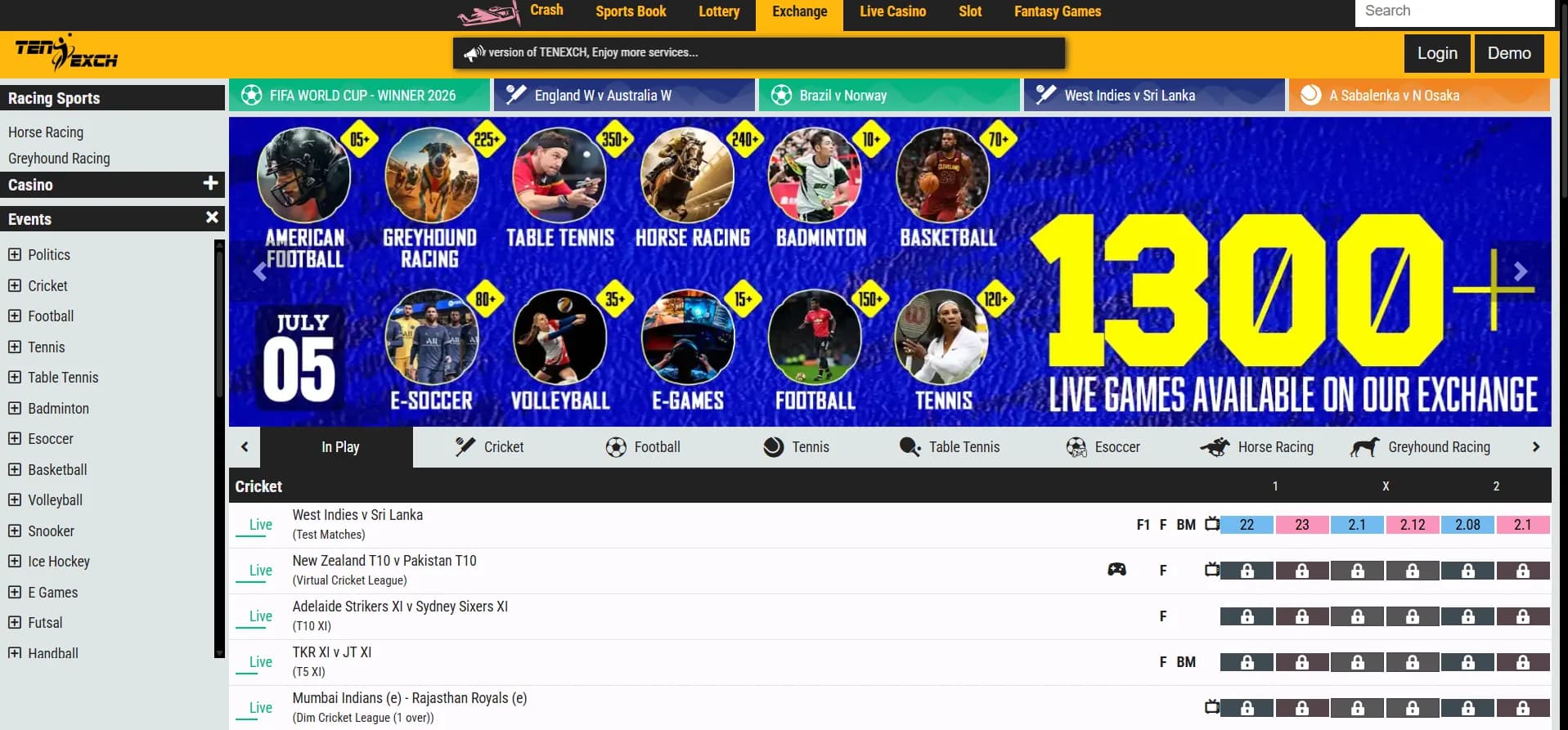
Tenexch is a betting exchange platform built on the same diamond-exchange architecture pattern used across our sportsbook and betting exchange work — a low-latency, back/lay exchange system rather than a fixed-odds-only sportsbook. Like our other exchange builds, the platform is designed around real-time in-play pricing and a live betslip system, giving players direct peer-style exchange betting.
An Exchange, Not a Fixed-Odds Sportsbook
The defining choice behind Tenexch is that it runs as a true betting exchange rather than a house-banked sportsbook. Instead of betting against the operator, players back an outcome (betting on it to happen) or lay it (betting against it), and the platform matches those opposing positions against each other in real time. This peer-to-peer model is what gives an exchange its sharper, market-driven odds and its signature ability to let a user trade out of a position before an event finishes — locking in a profit or cutting a loss as prices move.
Supporting that model reliably is a demanding engineering problem. A matching engine has to pair back and lay orders within milliseconds, maintain a fair order book for every market, and stay consistent even when a single in-play moment — a wicket, a goal, a break of serve — pushes thousands of price updates through the system at once. The diamond-exchange pattern Tenexch is built on exists specifically to carry that kind of concurrency without falling behind the live action.
Real-Time Pricing and a Unified Betslip
At the heart of the platform is a live odds engine that recomputes in-play prices continuously as an event unfolds. A unified live betslip and open-bets view lets players see and manage every active position in one place, tracking exposure across markets without switching screens or losing the seconds that matter most during fast in-play betting. Because exchange users often hold several linked positions at once, that single-view design is central to the experience rather than a cosmetic add-on.
The Technical Foundation
The platform follows the same technical foundation as our other sportsbook and exchange projects — a React frontend, Node.js backend, WebSocket-driven live odds, and Redis-backed session management — built for the throughput a betting exchange needs during high-volume live events.
- React frontend — the interface re-renders only the odds cells that actually change on each update, keeping it responsive even on the mid-range mobile hardware where most players are.
- Node.js backend — an asynchronous, non-blocking runtime handles large numbers of concurrent connections and rapid-fire bet placement without the request queue backing up.
- WebSockets — live odds, bet-status changes, and score updates are pushed to each client the instant they happen, rather than relying on the slow HTTP polling a live exchange simply cannot afford.
- Redis — hot data such as active prices and the matching queue is held in memory, so orders are paired without a database round-trip on every request.
Keeping these four layers loosely coupled means each can scale on its own: the frontend can be served from a CDN edge, the backend can be replicated horizontally behind a load balancer, and the in-memory layer can be clustered as concurrency grows during a marquee fixture.
Data Sources and Integrations
An exchange is only as good as the data feeding it. Tenexch draws on the Diamond Exchange API as one of the core data sources powering this class of platform, and the same integration approach extends to premium market and pricing feeds through a clean API development layer that normalises inputs and fails over between providers if a feed drops. For teams coming from the classic exchange world, the back/lay model will feel familiar to anyone who has worked with the Betfair API.
Where This Fits for Operators
For an operator evaluating an exchange-style build, Tenexch shows how peer-to-peer trading, low-latency data, and high-concurrency infrastructure come together in a real production platform rather than a concept. The same architecture underpins our betting exchange development service, and it pairs naturally with a full sportsbook development offering when an operator wants both exchange and fixed-odds products under one roof. For a closer look at how the surrounding commercial model works, our guide to white label sportsbook solutions walks through how a platform like this can be launched under a new brand, on a timeline and budget an operator can plan around.
Settlement and Reliability
Once an event finishes, an exchange has to settle every matched position accurately and quickly. Tenexch resolves markets against official results, handling voids, partial matches, and recomputation as deliberate cases rather than afterthoughts, so player balances reflect the true outcome without manual intervention. Reliability underpins all of it: a betting exchange loses player trust the moment prices lag or a settlement is wrong, so the platform is built to stay consistent under the concurrency of a live event and to fail safe if a data feed drops. For an operator, that dependability during high-volume in-play moments is the difference between an exchange players return to and one they abandon after a single bad settlement.
Frequently Asked Questions
What is the Tenexch platform built on?
Tenexch uses a diamond-exchange architecture — a peer-to-peer betting exchange model with real-time in-play pricing — built on a React frontend, Node.js backend, WebSockets for live market data, and Redis for performance at scale.
Is Tenexch an exchange or a traditional sportsbook?
Tenexch is an exchange-style betting platform, where pricing and wagering follow a peer-to-peer exchange model rather than fixed bookmaker odds — real-time in-play pricing is core to how the platform works.
Do you build exchange-style platforms like Tenexch for other operators?
Yes. We develop betting-exchange platforms with the same diamond-exchange architecture — real-time in-play pricing, WebSocket-based market data, and a scalable Node.js/Redis backend — customized to each operator's markets and branding.
For more on this, see our White Label Sportsbook — kenya page for the full details.
Our Slot Game Development page covers this in more depth.
Tech stack